If you are devolper, you daily deal with approutes, if AI product company then dealing with https://airouter.io/ which routes to correct LLM based on your predecided rules. Routers are among the most fundamental elements of digital communication. Whether moving packets across the internet, forwarding function calls inside cloud platforms, directing API requests inside a web application, or selecting the right AI model, routing exists everywhere. For networking students, understanding the different categories of routers is essential. It helps you see how networking connects with cloud engineering, software development, cybersecurity, and AI systems.
This guide explains the full range of router types that exist today—from classic networking routers to modern cloud routers, API routers, AI routers, and more. The objective is clarity: simple explanations, many bullet points, and one consolidated table that lists router types along with common vendors or technologies where applicable.
What a Router Does (Simple Definition)
A router is a system that:
Receives inputs
Examines destination information
Selects the best-possible path
Forwards data to its next hop
In networking, that “data’’ is a packet.
In cloud systems, it may be traffic between VPCs.
In APIs, it is an HTTP request.
In AI systems, it is a user query routed to the right model.
Regardless of domain, routing always means intelligent forwarding.
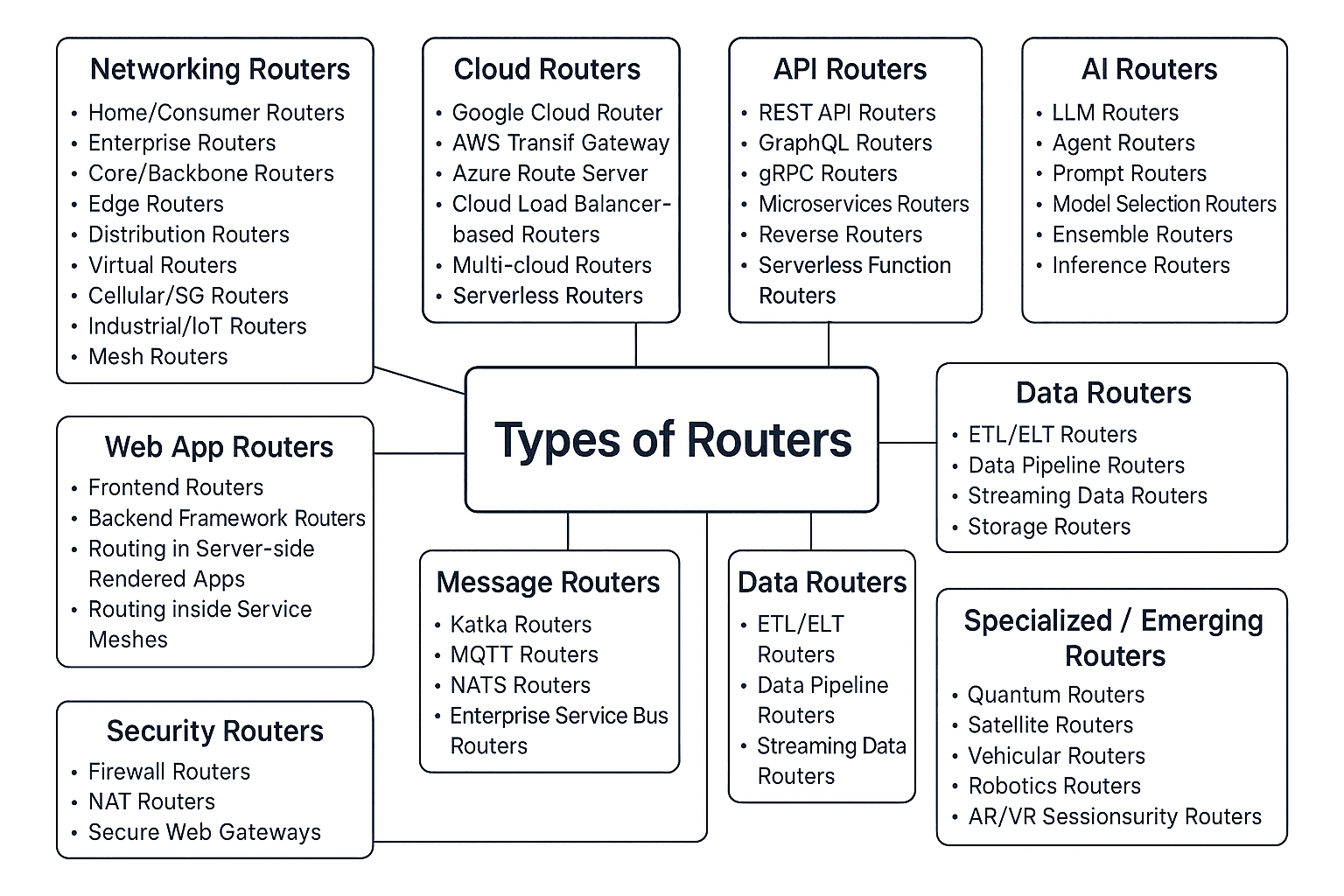
1. Networking Routers (Traditional and Enterprise)
Networking routers remain the foundation of the internet. They forward packets between networks using routing protocols (BGP, OSPF, IS-IS, EIGRP). They appear at home, campus, ISP backbone, data centers, and industrial environments.
Types of networking routers:
Home/Consumer Routers
Small Office / Branch Routers
Enterprise Core Routers
Data Center Routers
Edge Routers
Distribution Routers
Aggregation Routers
Virtual Routers (vRouters running on hypervisors)
Software-Defined Routers (SD-WAN routers)
Wireless Routers (WLAN routers, Wi-Fi 6/6E/7 devices)
Industrial/IoT Routers (rugged, environmental sensors)
Cellular/4G/5G Routers
Mesh Routers (distributed WiFi routing fabric)
Typical networking router capabilities:
2. Cloud Routers (Cloud Networking Components)
Cloud networking uses virtualized routing components to connect VPCs, VNets, on-prem data centers, or multi-cloud networks. They handle dynamic routes, BGP adjacencies, and traffic distribution across cloud resources.
Examples and types:
Fully-managed cloud routers
Transit routers (hub-and-spoke)
Multi-cloud routers
Cloud WAN routing fabrics
Serverless routing layers
VPC-to-VPC route managers
SD-cloud edge routers
Capabilities in cloud routing:
BGP-based dynamic routing
Cross-region connectivity
Hybrid cloud and on-prem connectivity
Route advertisements
Policy-based traffic steering
Inter-cloud traffic optimization
3. API Routers (Software & Application Routing)
API routers direct incoming HTTP/gRPC/WebSocket requests to specific handlers or services inside an application.
Types:
REST API routers
GraphQL routers
gRPC routers
Microservices routers inside service meshes
Reverse routers (for backend selection)
Serverless function routers
Common routing features:
Route matching and path parsing
Parameter and body validation
Middleware handling
Rate-limiting and authentication
Distributed microservice routing
4. Web Application Routers (Frontend & Backend Routing)
These routers map URLs to screens, components, controllers, or pages.
Types:
Frontend routers (client-side single-page applications)
Backend framework routers (MVC/MVT controllers)
Routing in server-side rendered web apps
Routing inside container service meshes
Typical routing tasks:
Path → Component mapping
Lazy loading routes
Nested routing
SEO-oriented routing
Middleware integration
5. Message Routers (Event & Queue Routing)
Event-driven systems use message routers to forward streams or events.
Types:
Kafka routers
MQTT routers
NATS routers
AMQP brokers (as routing devices)
Enterprise Service Bus (ESB) routers
Stream processing routers
Capabilities:
6. AI Routers (Model, Agent, and Prompt Routing)
AI systems frequently use routing to send queries to the most appropriate model, agent, or tool.
Types:
LLM routers
Agent routers
Prompt template routers
Model selection routers
Tool/action routers in agent frameworks
Edge AI routers (decide edge vs cloud inference)
Ensemble routers (voting/selection pipelines)
AI routing enables:
Specialized model selection
Cost optimization
Faster inference
Higher accuracy depending on task
Auto-scaling of workloads
7. Data Routers (Data Pipeline, ETL, & Storage Routing)
Data systems need routers that forward jobs, datasets, or stream partitions.
Types:
They assist with:
Data transformation routing
Schema-based routing
Storage tiering decisions
Data replication path selection
8. Security Routers (Routing with Enforcement)
Security routers enforce security and routing rules simultaneously.
Types:
They often combine:
9. Specialized / Emerging Routers
Modern tech introduces new kinds of routers beyond classical networking.
Types:
Quantum routers
Satellite routers
Vehicle/Automotive routers (V2X)
Drone/UAV routers
Robotics routers (ROS routing)
AR/VR session routers
High-frequency trading routers
Industrial automation routers
They support:
Comprehensive Router Types Table (with Vendor Examples)
The table below summarizes router types and example vendors or technologies. These are illustrative, not exhaustive.
| Router Type | Sub-Types | Vendor / Technology Examples |
| Home/Consumer Routers | WiFi 5/6/6E/7, Mesh routers | TP-Link, Netgear, Asus, Linksys |
| Enterprise Routers | Branch, WAN, campus routers | Cisco ISR/ASR/Catalyst, Juniper MX/SRX, HPE Aruba, Fortinet |
| Core/Backbone Routers | ISP-level, high-performance | Cisco NCS, Juniper PTX/MX, Nokia 7750 SR |
| Edge Routers | Provider edge (PE), internet edge | Cisco ASR, Juniper MX, Mikrotik CCR |
| Data Center Routers | Spine-leaf, fabric routers | Arista 7000 series, Juniper QFX/MX, Cisco Nexus |
| Virtual Routers (vRouters) | Software-based routing | VyOS, pfSense, FRR, Juniper vMX, Cisco CSR1000v |
| SD-WAN Routers | Cloud-managed WAN routers | Cisco Viptela, Fortinet SD-WAN, VMware VeloCloud, Palo Alto Prisma |
| 5G/4G Routers | Cellular routers | Cradlepoint, Teltonika, Huawei, Peplink |
| Industrial/IoT Routers | Rugged routers, SCADA integration | Siemens SCALANCE, Moxa, Advantech, Cisco IR1101 |
| Mesh Routers | Multi-node WiFi routing | Google Nest WiFi, Eero, TP-Link Deco |
| Cloud Routers | Managed BGP routers, cloud WAN | Google Cloud Router, AWS Transit Gateway, Azure Route Server |
| API Routers | REST/gRPC/GraphQL routers | FastAPI Router, Express Router, Flask Blueprint, GraphQL resolvers |
| Web App Routers | Frontend/Backend routing | React Router, Vue Router, Angular Router, Django URLs |
| Service Mesh Routers | Microservice routing | Istio Envoy, Linkerd, Consul Connect |
| Message Routers | Event-stream routers | Kafka, RabbitMQ, NATS, MQTT brokers |
| AI Routers | LLM, agent, model selection routers | LangChain Router, Semantic Router, RAG routing tools |
| Data Routers | ETL/ELT, pipeline routing | Airflow, Dagster, Prefect, Kafka Streams |
| Security Routers | Firewall routers, SWG, ZTNA | Palo Alto NGFW, FortiGate, Zscaler, Cisco Firepower |
| Satellite Routers | Starlink and VSAT routers | SpaceX Starlink, Viasat, HughesNet |
| Quantum Routers | Quantum communication routers | Toshiba QKD Router (R&D), Quantum Xchange |
| Automotive Routers | V2X communication | Bosch, Continental, Harman |
Conclusion: Why Students Must Know All These Router Types
Understanding routers is no longer limited to packet forwarding in LANs or WANs. Modern routing now includes: