Namoh Firewall and Router
Lately, I have been working on a project that has quietly grown into something far bigger than I initially imagined—Namoh Router, a cloud-grade virtual router and firewall built with a fresh perspective. This idea did not come from a boardroom, an investment pitch, or a market analysis report. It came from life, from my personal journey, from many years of working in networking, from the way I mentor students, and from the way I see India’s engineering talent moving toward the global cloud era.
This blog is both a story and a blueprint. A story of how Namoh Router began. A blueprint of where it is headed.
The Early Spark: Engineering the Indian Way
Sometimes our engineering instincts are born not in classrooms, but in childhood curiosity. Mine started the day I opened up our family VCR. That device never worked again, but something began working inside me—an uncontrollable urge to break things, understand them, rebuild them, and re-imagine them.
During engineering college, I realised that what they called “engineering” was mostly theory. My kind of engineering was different. It was hands-on, messy, experimental, and driven by obsession. It was R&D in its rawest form. The classroom never matched the energy of building, testing, breaking, and rebuilding. That disconnect stayed with me for years.
Life, however, had other plans. Before I turned 18, I suffered from severe kidney complications and bone tuberculosis. I spent almost one and a half years bedridden. The treatment for MDR TB damaged my kidneys further, and the years that followed were a slow struggle with health and memory. I carried that burden until the age of 47, when my kidneys completely failed and I finally underwent a transplant in July 2025.
A new life began after that—literally.
Why Namoh Router Was Born
With my regained energy, I returned to what I loved: building. While creating my own lab on an online pod, I needed a reliable, production-grade firewall and router. Something that could handle 1 Gbps throughput, offered clean UI/UX, and was cost-effective. Most solutions in the market fell into two categories:
Too expensive for students, labs, startups, and small setups
Too complex for beginners, even though I personally could handle it (I have 2 CCIEs for 17 years)
Platforms like pfSense, AWS Security Groups, and DigitalOcean Firewalls provided ideas but not a complete solution. Cloud firewalls were simple but lacked depth. Traditional open-source routers were powerful but overwhelming.
I realised there was a gap.
India needs a firewall that students can learn from.
Startups need a router they can afford.
Cloud engineers need something that matches modern cloud workflows.
Labs need something fast, lightweight, and scalable.
That was the origin of Namoh Router—a combination of cloud simplicity, pfSense-grade depth, and a modern Indian engineering mindset.
By the time of writing this blog, our Stage-1 Router is already in production within our own environment. Early performance metrics are promising, and the feedback loop is active.
The next five phases will transform Namoh Router into a world-class platform.
What Makes Namoh Router Different
1. Simplicity with Power
Modern networking doesn’t need 40 tabs and 200 options. It needs defaults that work, and controls that make sense.
Namoh Router cleans up the clutter and offers:
2. Cloud-first Architecture
Instead of replicating traditional router models, the system aligns with cloud-native design:
API-driven
metadata-aware
declarative policies
dynamic rules
By adopting optimized nftables, kernel enhancements, and asynchronous processing, the system is designed to reach:
4. Built for Indian Developers & Students
Networking education in India often suffers from lack of hands-on tools. Namoh Router aims to fix that:
Five-Phase Roadmap for Namoh Router
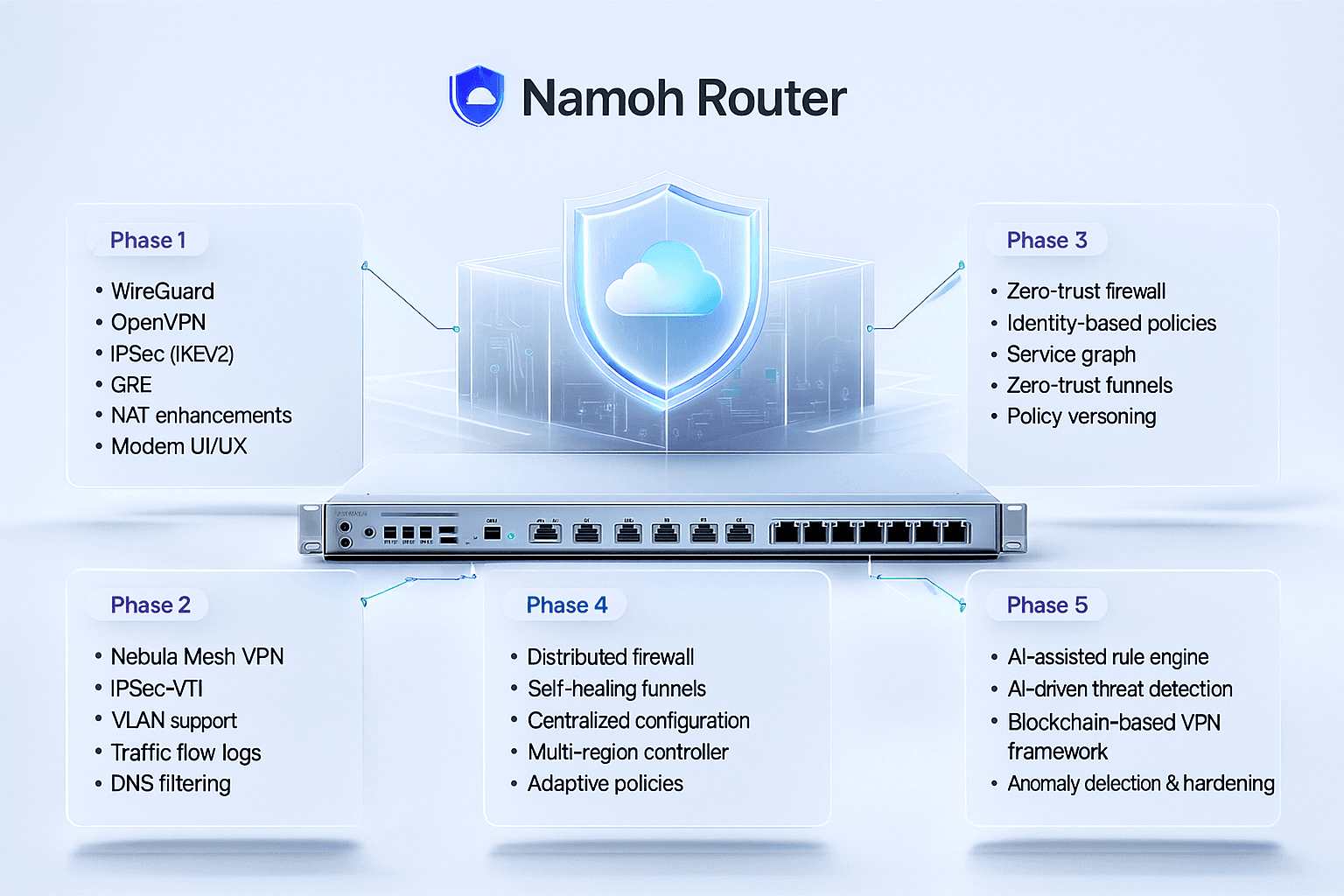
We have structured upcoming development into five strategic phases. Each phase includes features grouped by complexity.
Feature Phases wise
| Phase | Complexity Level | Feature Set |
| Phase 1 | Low–Medium | WireGuard, basic IPSec (IKEv2), GRE, OpenVPN, improved NAT, modern UI |
| Phase 2 | Medium | Nebula Mesh VPN, advanced IPSec (VTI), VLAN support, DNS filtering, flow logs |
| Phase 3 | Medium–High | Zero-Trust firewall, identity-based policies, service graph, policy versioning |
| Phase 4 | High | Distributed firewall mode, multi-region controller, self-healing tunnels |
| Phase 5 | Very High | Blockchain-based VPN framework, AI-driven rule engine, anomaly detection and auto-hardening |
Phase 1: Tunneling Foundation and UI Stability
Our current stage in production already supports basic routing and firewalling. Phase 1 will strengthen it with essential VPN and tunneling features.
Core Features
WireGuard (multi-peer, high-performance)
OpenVPN (site-to-site and client-based)
Basic IPSec (IKEv2) support
GRE tunnels for compatibility with legacy systems
NAT Enhancements
One-to-one NAT
Port forwarding
Hairpin NAT
Modern UI/UX
intuitive dashboard
rule grouping
real-time notifications
Goal of Phase 1
Bring the router to a level where it can replace low to mid-tier virtual routers used in labs and small businesses.
Phase 2: Mesh Networking and Deep Network Controls
Phase 2 adds features suitable for distributed teams, modern developers, and hybrid network environments.
Advanced VPN & Networking
Nebula Mesh VPN support
IPSec VTI Mode for dynamic routing
VLAN and Trunking Support
Static and Dynamic DNS filtering
Traffic Flow Logs with insights
Cloud-Style Rule Templates
Users can apply rule templates like:
Web Server Template
DB Tier Template
Kubernetes Node Template
Goal of Phase 2
Enhance compatibility, improve visibility, and enable large-lab and remote-access use cases.
Phase 3: Zero-Trust & Smart Policies
After establishing strong connectivity and stability, Phase 3 shifts Namoh Router into modern cloud and zero-trust territory.
Identity-Based Security
Rules based on:
IP addresses become optional rather than mandatory.
Zero-Trust Tunnel Access
Grant selective application access across tunnels.
Service Graph Visualization
A live graph showing:
traffic
blocked flows
latency
tunnel states
Policy Versioning
rollback
compare revisions
audit trail
Goal of Phase 3
Bring enterprise-grade security models to Indian labs, SMBs, and students in a simplified, modern interface.
Phase 4: Global and Distributed Architecture
This phase expands Namoh Router beyond a single-instance architecture.
Distributed Firewall Agents
Lightweight agents deployed across:
cloud regions
offices
data centers
All controlled by a unified management plane.
Self-Healing Tunnels
Centralized Configuration Management
Goal of Phase 4
Support large enterprises and multi-region startups with cloud-native routing and security.
Phase 5: The Intelligent & Decentralized Future
The final phase focuses on next-level innovation—where Namoh Router becomes an autonomous, intelligent, and secure cloud networking platform.
AI-Assisted Rule Engine
AI-based Threat Detection
Blockchain-backed VPN Framework
decentralized trust
tamper-resistant audit
multi-node federation
Adaptive Policies
Firewall rules automatically adapt based on:
server load
traffic patterns
risk levels
Goal of Phase 5
Position Namoh Router as a global innovator capable of competing with next-generation cloud firewall platforms.
Where Namoh Router Fits in the Indian Technology Landscape
India is rapidly becoming a cloud-first and network-first engineering nation. With lakhs of engineering graduates entering the IT workforce every year, we need tools that:
teach networking hands-on
are affordable
are India-built and India-optimised
prepare students for cloud careers
empower startups who cannot spend lakhs on proprietary firewalls
Namoh Router is designed with all these objectives in mind.
For Students
For Startups
secure workloads
low cost
high throughput
cloud-friendly workflows
For Enterprises